
September 28, 2026 · 11 min read
Making friends as an adult is a logistics problem
It is not that you got worse at friendship. The two conditions that used to produce it for free, without anyone deciding anything, quietly left your week.

There is a particular Sunday that most people recognise. Nothing is wrong. The week was fine, the flat is warm, there is food in the fridge. You have people you could text. You just do not, because texting someone to ask if they want to do something on a Sunday afternoon is a small proposal with a small risk attached, and it is easier not to.
What is strange about that Sunday is how recently it would have been impossible. At nineteen you did not schedule friendship. It happened to you, constantly, whether or not you had the energy for it. Someone knocked. Someone was already in the kitchen. You did not decide to see people four times a week, you simply could not avoid it.
The usual explanation for what changed is that you got busy, or that people get worse at this as they age. Neither is quite right. What actually changed is more mechanical, and once you can see it, it stops feeling like a personal failure.
Two conditions you used to get for free
Friendship has a couple of unglamorous prerequisites. Research has been circling them for about seventy-five years, and they are both about logistics rather than chemistry.
The first is proximity, and it matters far more than anyone expects. In 1950 three researchers at MIT, Leon Festinger, Stanley Schachter and Kurt Back, studied a housing complex full of returning servicemen doing graduate degrees. Families were assigned to apartments more or less arbitrarily. The researchers asked residents to name their three closest friends, and found that about two thirds of those friendships were with people living within a few units of them.
Read that again, because it is genuinely odd. These were adults with formed personalities, histories and interests, and the strongest predictor of who they were close to was not any of that. It was the floor plan. People became friends with whoever they kept passing. The residents who had friends across multiple floors were mostly the ones who lived next to the stairwells.
The second condition is time, and there is a number on it. Jeffrey Hall, a communication studies researcher at the University of Kansas, tried to work out how many hours friendship actually costs. Studying adults who had recently moved somewhere new, he found it took roughly fifty hours together to turn an acquaintance into a casual friend, around ninety to become an actual friend, and more than two hundred before someone counted as a close one.
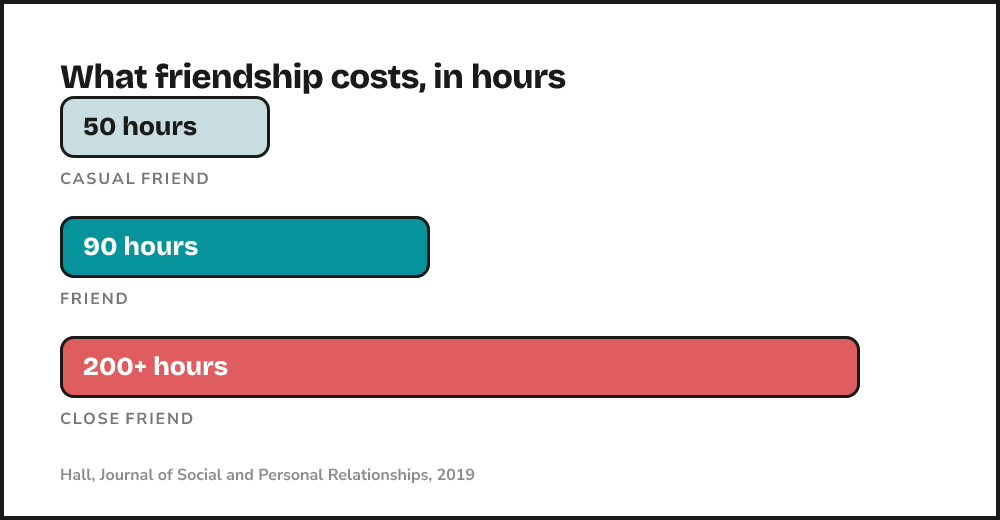
One detail in that work matters more than the headline. Hours spent working alongside someone counted for much less. Time is necessary but not sufficient. It has to be time where nothing in particular is being accomplished.
Why this used to be invisible
Put those two conditions together and school looks less like a place you learned things and more like a machine for manufacturing friendship.
It supplied proximity you did not arrange: the same building, the same corridors, the same faces at the same times. It supplied unstructured hours in enormous quantity, because the gaps between obligations were spent in the company of whoever else was in the gap. And it supplied repetition without anyone having to propose anything. Nobody texted to ask if the others wanted to be in the common room. They were in the common room.
Two hundred hours is roughly an hour a day for most of a year. That sounds impossible now. It was trivially easy then, because nobody was counting, and nobody had to ask.
What ended was not your capacity for friendship. It was the infrastructure that had been quietly supplying its two inputs. Adulthood removes the building, the corridors and the gaps, and hands you a calendar instead. Every hour that used to arrive by default now has to be proposed, scheduled, and protected from everything else competing for it.
Why the standard advice does not work
The advice people give is to put yourself out there. Go to more things, meet more people, say yes more often. It is well meant, and for most people it does not work, because it is aimed at the wrong variable.
Meeting more people produces acquaintances, and acquaintances are not what is missing. Most people who feel isolated in a new city can name plenty. What they cannot name is the four or five who would text on a Tuesday for no reason.
Turning an acquaintance into that takes the two conditions above, and a one off event supplies neither. You get ninety minutes with someone, which is under two percent of the way to a casual friend, and then the two of you are responsible for manufacturing the next ninety by yourselves. That means somebody has to suggest something, pick a time, find a place, and do it again next month. Every single time. Against work, distance, tiredness and the quiet fear of seeming keener than the other person.
Almost nobody sustains that, and it is not a character flaw. It is a lot of overhead for an uncertain return, repeated indefinitely. The system asks each person to personally rebuild, by force of will, the repetition that a corridor used to provide for free.
There is a second failure hiding in the advice, which is that it optimises for volume when the binding constraint is fit. A room of fifty people you have nothing in common with is lonelier than a room of four you do. Volume feels like progress because it is measurable. It mostly produces more names.
But you already have friends
The obvious objection is that you are not short of friends at all. You have the ones from school, from your last job, from the city you left. Some of them know you better than anyone you could plausibly meet now. So why does the Sunday still happen?
Because closeness and availability are different things, and only one of them solves a Sunday.
A friendship built over two hundred hours does not evaporate when someone moves away. That is the good news about the hours: once paid, they hold. Old friendships survive distance remarkably well, and picking up after a year apart is genuinely possible in a way that it is not with an acquaintance.
What distance does remove is the ordinary kind of contact. Not the two hour phone call that catches up on everything, which is lovely and takes planning. The other thing. Somebody being around while you do something unremarkable. Being seen on a normal day rather than an update-worthy one.
The friendships you already have are not a substitute for that, and no amount of maintaining them will make them one. They are also, quietly, part of why the local gap is hard to admit to. It feels absurd to say you are short of friends when your phone is full of people you love. The two facts sit together perfectly comfortably, and almost nobody says so out loud, which is most of why this feels like a private failing rather than the completely ordinary structural problem it is.
It is not a confidence problem
Worth saying plainly, because the advice tends to assume otherwise: for most people this is not social anxiety, not a skills deficit, and not something to fix in yourself before you are ready.
The people who describe the Sunday are usually not awkward. They are often extremely good at the part everyone frets about. They can hold a conversation, they get invited to things, they are liked at work. What they lack is not the ability to make a friend. It is a recurring, low effort occasion in which the fifty hours could accumulate.
That distinction matters because it changes what you go looking for. If you believe the problem is you, the solution is self-improvement, and you spend a year working on yourself while the structural gap stays exactly where it was. If you can see the problem is scheduling, the solution is a different shape entirely, and it is one you can actually build.
What actually works
If the problem is the loss of proximity and unstructured repeated hours, then the answer is not to meet more people. It is to deliberately rebuild the conditions, at a scale small enough to survive real life.
Something that repeats on its own. The single most useful property is that the next occasion already exists without anyone proposing it. A standing thing. A weekly thing. Something where showing up is the default and absence is the decision, rather than the other way round. This is the closest adult equivalent to the corridor, and it removes the overhead that kills most new friendships in their first month.
Small enough that everyone is in it. Past about eight people a conversation splits or someone starts presenting, and most of the room becomes an audience. Below about four, one person being busy ends the evening. Five to seven holds a single conversation where everyone participates, and absorbs two people cancelling without the whole thing collapsing. That resilience is what gets a group through the month when everyone is slammed, which is the month that kills most new friendships.
The same people, not new ones. Every friendship you value came from seeing the same person repeatedly, usually for a boring structural reason rather than a romantic one. Rotating through new faces resets the clock on the fifty hours every time.
Chosen for fit, not proximity alone. This is the one thing the 1950 study got by accident and you cannot. Those residents were thrown together by a floor plan and made it work because the repetition was relentless. You will not get relentless repetition, so the people have to be worth the hours you do get.
If you want something to do this week
The abstract version of this is easy to agree with and hard to act on, so here is the concrete translation.
Pick the thing that repeats, not the thing that sounds best. A mediocre weekly occasion beats an excellent monthly one, because the weekly one accrues hours and the monthly one mostly accrues intentions. Frequency is doing more work here than quality.
Give it longer than feels reasonable before judging it. Four sessions in, you are perhaps eight hours deep. That is a sixth of the way to a casual friend. The instinct at that point is that it is not working, when in fact nothing has gone wrong at all and you are simply early. Most people quit somewhere in here, which is precisely where the returns are about to start.
Optimise for the same faces. If there is a version of the thing where you see the same people each week and a version where the room turns over, take the first one even if the second is better on paper.
And lower the bar for what the occasion has to be. It does not need to be interesting. The 1950 study did not find that people became friends over shared passions. They became friends because they kept walking past each other. The activity is mostly a pretext for the repetition, and treating it as a pretext takes a surprising amount of pressure off.
The honest version
None of this makes friendship effortless, and anyone promising that is selling something. Two hundred hours is two hundred hours. There is no version where closeness arrives without them.
What can change is how much of that time you have to personally organise. That is the actual difference between the friendships you made at nineteen and the ones you are trying to make now. Not effort, not charisma, not how interesting you are. Logistics.
This is what The Village is built around, and it is why a Circle is five to seven people who meet in real life rather than a feed of everyone nearby. The point is not to introduce you to more people. It is to give back the thing adulthood quietly took away: a small group of people you genuinely fit with, seen often enough that seeing them stops being a decision.
You do not need more people. You need the right ones, often enough that it becomes ordinary.
The research referenced here is Festinger, Schachter and Back’s 1950 Westgate studies on proximity and friendship formation, and Jeffrey Hall’s 2019 paper in the Journal of Social and Personal Relationships on the hours friendship takes.