
November 10, 2026 · 8 min read
The best way to meet people in 2027 is a Circle
Apps, mixers and classes all solve part of meeting people. Here is how The Village puts the parts together, and why January is the time to start.

It is the second week of January. You have decided that this is the year you actually meet people. So you download two apps, sign up for a mixer on Thursday, and save a run club to your phone.
By March, the apps have produced three pleasant coffees with people you never saw again. The mixer was fine. You went to the run club twice, then it rained, then you were busy. You know more names than you did in January. You do not have more friends.
That is not a failure of effort. Each of those things does one part of the job well and leaves the rest to you. The Village was built to do the whole job: put you with people you fit, in a group the right size, meeting again and again until they are your people.
The short version, if you are skimming:
- Meeting people is easy. Seeing the same people again is the hard part.
- A Circle is five to seven people, put together for fit, who meet in real life.
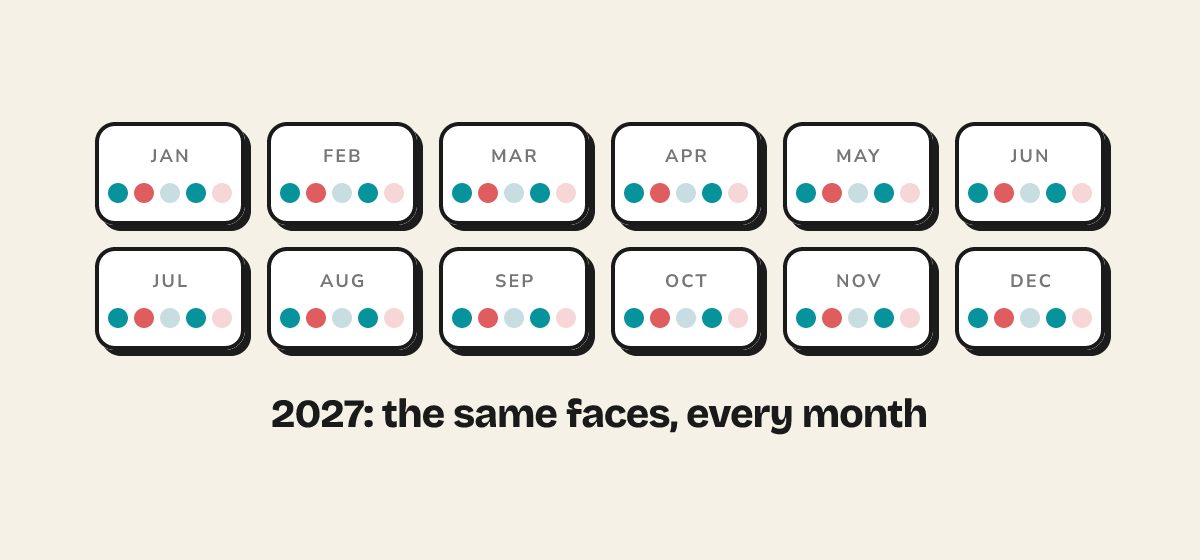
- The next meeting is already on the calendar, so nobody has to organise it.
- It takes what works about apps, mixers and classes, and drops what does not.
- January is the best month of the year to start.
Why meeting people got harder
If it feels harder than it used to, the numbers agree with you.
The US Surgeon General’s 2023 advisory on loneliness found that people aged 15 to 24 spent about 70 percent less time socialising with friends in 2020 than in 2003. Most of that decline came before the pandemic, not because of it.
Part of the reason is that the places that used to do the work stopped doing it. The Survey Center on American Life found in 2021 that 54 percent of Americans with close friends had met one at work, theirs or their partner’s. Work was never designed to make friends. It just put the same people in the same room five days a week. When that room became a video call for a lot of people, nothing replaced it.
So in 2027, meeting people is something you have to arrange on purpose. The Village is that arrangement.
What it actually takes to make a friend
Friendship runs on time together, and more of it than most people guess. Jeffrey Hall’s research at the University of Kansas found it takes around 50 hours to go from acquaintance to casual friend, around 90 to become a friend, and more than 200 to become a close one.
Two things follow.
The hours have to be with the same people. Fifty hours spread across fifty strangers makes no friends. Fifty hours with the same five people makes several.
The hours have to happen without a decision each time. If every meeting needs someone to suggest it, schedule it and chase it, most of them will not happen.
Every way of meeting people can be judged by those two points. Here is how the usual ones do, and what a Circle does differently.
Better than one-off events
What they get right: they get you out of the house and into a room of people who also want to meet someone.
Where they fall short: the room changes every time. You might have a great conversation, but nothing about the evening brings you back to that person. Turning it into a second meeting means asking for a number, following up and finding a date, which is exactly the decision that quietly never gets made.
What a Circle does instead: you meet the same five to seven people each time. The second meeting is not something you have to ask for. It is already on the calendar, and so is the one after that.
Better than friend apps
What they get right: introductions. You can line up three coffees in an afternoon.
Where they fall short: a coffee with a stranger is one hour of the 50. After it, two people who barely know each other have to schedule the second hour, with no shared place to be and no group to fold into. One-on-one plans between near strangers are the easiest plans in the world to cancel.
What a Circle does instead: you are never trying to build a friendship one coffee at a time. You join a group, and the group meets whether or not any two people in it have texted each other that week.
Better than volunteering
What it gets right: a reason to show up, and something to talk about that is not small talk.
Where it falls short: turnover. Many roles rotate who works when, so a shift full of different people each week is closer to an event than a group.
What a Circle does instead: the group stays the same. The people you meet in January are the people you are still seeing in June.
Better than classes and clubs
What they get right: this is the closest of the usual options. A pottery class that runs for eight weeks or a league with a fixed team gives you the same people, at the same time, every week.
Where they fall short: the group is put together by interest in an activity, not by how well you get on. You can spend eight weeks next to people you like but have little else in common with. Then the session ends, and often so does the connection.
What a Circle does instead: the group is put together for compatibility from the start. Before you join, you have a short chat with Milo, The Village’s AI helper, about what you value, how you actually spend your time and where you are in life. Your Circle is built from that. And it does not end after eight weeks. It keeps meeting.
Better than starting your own group
What it gets right: a small group with a standing date is the best format there is. If you can pull it off, it works.
Where it falls short: it depends on you already knowing the right four to six people, and on you being the one who organises every single time. Most of these groups last until the organiser has one busy month.
What a Circle does instead: you do not need to know anyone first, and you are not the organiser. The next date is set for everyone, so the group does not hang on any one person’s energy.
Why five to seven people
The size of a Circle is the most deliberate number in how The Village works.
Above about seven, a table stops being one conversation. Research on conversation size from Robin Dunbar’s group suggests a single conversation tops out around four speakers before it splits. At twelve people you talk to the three nearest you and never meet the rest.
Below five, one busy week ends it. A group of three where one person cancels is two people and an awkward text. Five to seven absorbs that: two people can miss it and it is still a real evening.
That is the band where everyone gets to know everyone, and where the group survives the month when everyone is slammed. There is more on this in why a Circle is five to seven people.
Why January is the right time to start
Nearly everyone sets out to change something in January. That works in your favour.
In January, the people you meet are making the same fresh start you are. Starting a Circle then means your first few meetings land while everyone in the group is in that frame of mind.
The catch is February. That is when motivation fades and plans that depended on it fall away. This is where a Circle earns its place. You do not need motivation to go to something that is already on your calendar with people who expect you. By the time February arrives, you are not deciding whether to keep going. You are just going.
What a Circle will not do
It will not hand you five best friends in a month. Nothing can. Two hundred hours is two hundred hours, and there is no version where closeness arrives without them.
What it does is make sure those hours actually happen, with people who fit you, without you having to organise any of it. Stay with it through the year and that is a few dozen evenings with the same faces. That is most of the way to a casual friend with everyone in the group, and a real start toward something closer with some of them.
Make 2027 the year it sticks
You do not need to meet more people in 2027. You need to keep meeting the same ones, often enough that seeing them stops being a decision.
That is what a Circle is for. Have the chat with Milo, meet your Circle, and let the calendar do the part that used to fall through. Join The Village and start the year with your people already on the calendar.
The figures here come from the US Surgeon General’s 2023 advisory on loneliness and isolation, the Survey Center on American Life’s 2021 report on American friendship, Jeffrey Hall’s 2019 paper in the Journal of Social and Personal Relationships on the hours friendship takes, and Dunbar and colleagues’ work on the size limit of a conversation.