
November 4, 2026 · 7 min read
Friendsgiving is easy to cook and hard to fill
The turkey is the easy part. A guide to Friendsgiving that starts with the harder question of who sits at the table, and what to do if you are not sure yet.

Somewhere around the first week of November, a message lands in a group chat. “Are we doing Friendsgiving this year?” Four people react with a thumbs up. Nobody answers the question. By the twentieth it has quietly become a thing nobody is doing, and everyone is slightly relieved and slightly sad about it.
Or the other version. You moved here in the spring. Everyone at work is flying home on Wednesday night. You are not, because the flight costs what it costs, or home is complicated, or you simply want one holiday that belongs to the life you are building here. And when you go to picture the table, you realise you are not sure who would be sitting at it.
Both of those are the same problem. Friendsgiving is a dinner, and dinners are not hard. What is hard is the guest list. This guide is about both: how to host one well, and how to find the right people to host it with.
The short version, if you are skimming:
- Invite five to seven people. Past eight, the table splits into separate conversations.
- Choose for fit, not for who would be awkward to leave out.
- Pick the weekend before Thanksgiving unless most of your guests are staying in town.
- You cook the main. Everyone else brings a category, not a specific dish.
- Set the next date before anyone leaves. That one step does more than everything else here.
A holiday named after the people, not the food
Friendsgiving is young. Merriam-Webster traces the earliest written uses of the word to 2007, in casual posts that used it without bothering to explain it, and added it to the dictionary in 2020. The idea is older than the word, of course. People have always eaten with friends in November. The word just gave the meal permission to be its own thing rather than the consolation prize for not going home.
Notice what the name puts first. Thanksgiving is named after the occasion. Friendsgiving is named after who is in the room. That is the whole difference between the two, and it is why the guest list carries so much more weight.
At a family Thanksgiving, nobody chose the table. You did not pick your uncle. The meal works, when it works, because the people share decades of history, and the history carries the evening even when the conversation does not.
A Friendsgiving has no history to lean on. Every person at it is there because somebody decided they should be. So when it goes well it is often the best meal of the year, and when it goes badly it is twelve people who half know each other, eating dry stuffing and checking the time.
The hard part is not the turkey
Ask people what worries them about hosting and they name the food. Will the turkey be done. Is there enough. What about the person who is vegan. Those are real questions, and they all have answers you can look up in five minutes.
The question with no lookup is who to invite. It hides inside smaller questions that feel logistical and are not:
- Do you invite the work friend you get on with but have never seen outside the office?
- Can you mix your climbing people with your college friends, or will they sit at opposite ends?
- If one person brings a partner, does everyone get a plus one?
- Is it rude to invite five people from a group of seven?
Each of those is really a question about fit. Will these particular people, in this particular room, have a good evening together? And fit is the thing almost every piece of Friendsgiving advice skips, because it is harder to write a checklist for than a brine.
How many people to invite
There is a better answer to this than “however many fit”, and it comes from research on conversation rather than catering.
Robin Dunbar’s group at Oxford studied how many people can hold a single conversation, and found the ceiling is around four speakers. Add a fifth and the talk tends to split in two rather than grow. Holding a conversation means keeping track of what everyone else knows and is about to say, and most people can only carry a few other minds at once.
At a dinner table you can watch it happen. Twelve people sit down meaning to have one conversation. Within ten minutes there are two, sometimes three. You talk properly to the two people beside you and the one across, and you leave having barely spoken to the rest. Whoever sits at the hinge between two conversations spends the night turning their head back and forth and saying very little.
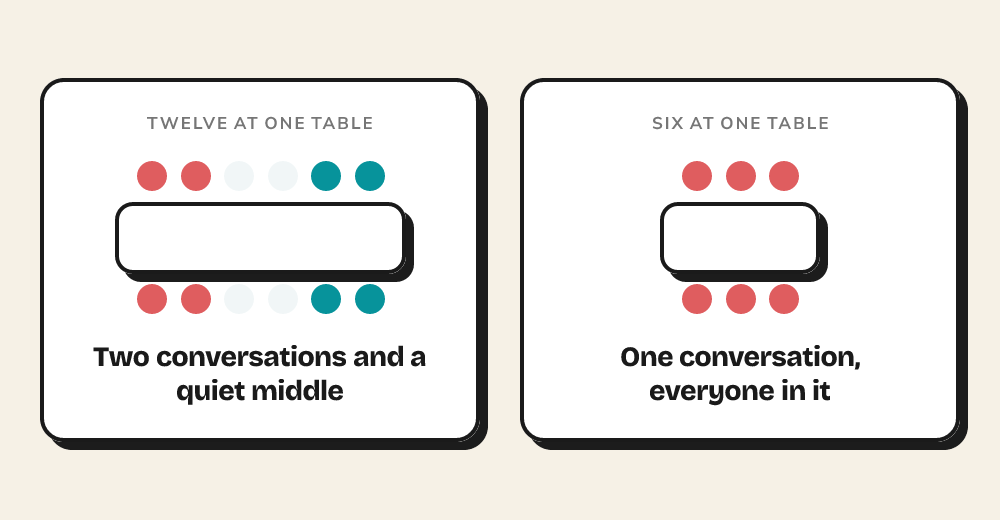
A table of five to seven behaves differently. The conversation still splits, but it splits and rejoins all evening: two people in the kitchen, three on the couch, everyone back together for dessert. By the time people leave, everybody has spoken properly to everybody. That is the evening most people are picturing when they say they want a Friendsgiving.
So if you are choosing, choose smaller. Six people who all talk beats fourteen who mostly do not. If your list keeps growing past eight, you are probably hosting two dinners at one table, and it might be kinder to host two dinners.
Who to invite: fit over volume
Once the number is small, each seat matters more. A few things predict a good table better than how much you like each person on their own.
People at a similar point in life. Not the same job or the same age. The same kind of week. A table where everyone is a few years into a new city has a lot to say to each other. A table where half the people have toddlers and half are planning their next trip tends to split along that line by the second glass of wine.
People who want the same evening. Some people want a long, loud night that ends with a card game at one in the morning. Some want to be home by ten. Neither is wrong. Putting both at one table means somebody spends the evening being polite about it.
No more than one group that already knows each other. Three college friends at a table of six is fine. Three college friends, three people from work and two climbing partners is three tables that happen to share a turkey. The host ends up as a translator, explaining everyone’s references to everyone else.
Nobody who is only there because leaving them out felt awkward. Every host has done this. It is almost always the wrong call, for them as much as for you.
None of this is about inviting the most impressive people you know. A table of six people with great stories who all want the floor is a worse evening than six who are curious about each other. Interesting is overrated at a dinner table. Comfortable is underrated.
When you do not have the people yet
This is the section most Friendsgiving guides leave out, and it is the reason a lot of people search for one.
Maybe you moved recently. Maybe your friends from before have scattered, or coupled up, or started families and go to their in-laws now. Maybe you have people you love, but they live somewhere else, and the people here are acquaintances you have never had over. It is an extremely common position to be in, and it gets more noticeable in November, because the holidays make the gap visible.
You have a few honest options.
Invite the acquaintances anyway. The coworker you always end up talking to. The person from your gym class. The friend of a friend you liked at that birthday. Most of them are in the same position as you and would be delighted to be asked. The risk is lower than it feels: the worst case is a polite no.
Join someone else’s. Mention to two or three people that you are staying in town. A surprising number of tables have one empty chair and a host who would love to fill it.
Make it a beginning rather than a finale. This is the most useful reframe. A Friendsgiving with people you met recently is not a failure to have closer friends. It is one of the first hours toward them.
The research is clear that friendship runs on time. Jeffrey Hall at the University of Kansas found it takes around fifty hours together to turn an acquaintance into a casual friend, ninety to become a friend, and more than two hundred to become a close one. One long dinner is four or five of those hours. That is not much. But it is four or five hours that would not otherwise have happened, and a holiday dinner is unusually good at making them count. People are relaxed. Nobody is checking their work phone. There is a reason to linger.
The catch is what happens after. A one off Friendsgiving, however lovely, leaves everyone at hour five with no plan for hour six. That is where most new friendships quietly stall: not because anyone stopped liking each other, but because nobody arranged the next time.
Why a Circle makes a good Friendsgiving table
This is the problem The Village was built to solve, and Friendsgiving happens to be a near perfect example of it.
A Circle is five to seven people, picked for how well you actually fit together, who meet in real life. Look back at the rest of this article and you will notice those are the answers to most of its questions.
It is already the right size. Five to seven is the band where one conversation holds the whole table, which is the reason Circles are that size in the first place. Nobody has to cut a list down or decide who sits at the hinge.
The fit was chosen on purpose. Before you join a Circle, you have a short chat with Milo, The Village’s AI helper, about what you value, how you actually spend your time, and where you are in life. Circles are put together from that, so the people at the table were picked because they line up with you, not because they happened to be in the same office or the same group chat. That is the part a host normally has to guess at, and usually gets slightly wrong.
Nobody is the translator. Everyone joined the same way, for the same reason, so there is no cluster that already knows each other’s jokes and no single host holding the evening together.
It does not end at hour five. This is the part that matters most. A Circle keeps meeting after the dinner, with the next time already on the calendar. So the Friendsgiving is not the high point of a friendship that then fades. It is one evening in a run of them, and the hours keep adding up in December, in January, in the quiet weeks when nobody would otherwise have suggested anything.
And if a Circle does not come together for you before the twenty sixth, that is fine. Friendsgiving has never been tied to one Thursday. Some of the best ones happen the weekend after, when everyone is back in town, or in early December, when the leftovers are long gone and the reason to see each other is just that you want to.
When to have Friendsgiving
There is no fixed date, which is part of the appeal. In 2026, Thanksgiving falls on Thursday, November 26, and Friendsgiving usually lands in one of three places around it.
The weekend before (November 21 or 22). The most common choice, and usually the right one. It catches people before they leave town, it does not compete with family plans, and nobody is already tired of turkey.
The Thursday itself. Best when most of your guests are staying put. The city goes quiet, nobody has work the next day, and the evening has nowhere else to be. For anyone who cannot or does not want to go home, a table on the actual day means a lot.
The weekend after, or early December. Underrated. Everyone is back, the travel stress is over, and the dinner stops being a stand-in for the holiday and becomes its own thing.
Pick the one that suits your guests rather than the calendar. Ask two or three of them before you announce a date, and you will know within a day.
A three-week plan
If you are reading this in early November, you have about three weeks. That is plenty.
Three weeks out. Pick the date and the guest list. Send the invitation: a date, a start time, an address, and one line asking what people do not eat. “We should do something” is not an invitation. It is the message from the opening of this article, and you know how it ends.
Two weeks out. Confirm who is coming and hand out food categories. Count your chairs, plates and glasses, and borrow what you are short of now rather than the night before.
The week before. Write the shopping list. If you are cooking a frozen turkey, work out when it needs to go in the fridge: the USDA advises about a day of thawing for every four to five pounds, so a sixteen pound bird needs about four days. Most first time hosts find this out on Wednesday.
The day before. Make anything that keeps: dessert, cranberry sauce, a dip. Set the table. Chill the drinks.
The day itself. Start the main early enough that it can rest while the sides finish. Leave the last hour before guests arrive for cleaning up the kitchen, not cooking in it.
How to host a Friendsgiving people remember
Whoever ends up at the table, the hosting itself is the easy part. A few things make it easier.
Cook the main, assign the rest by category. You make the turkey, or the main dish if there is no turkey. Everyone else gets a category rather than a specific dish, so they can bring the thing they actually cook well, without the classic outcome of five bags of rolls and no vegetables. For six people that might look like:
- You: the main, plus gravy
- Two guests: one side each, one of them green
- One guest: bread or a starter
- One guest: dessert
- One guest: drinks and ice
Ask about food in the invitation, not at the door. It saves someone from quietly eating only bread all night.
Plan for the gap. Guests arrive across about forty five minutes. Have something people can pick at and something to do with their hands. Asking an early guest to help with the gravy is one of the fastest ways to make someone feel like they belong in a room.
Go easy on the gratitude round. Going round the table to share what everyone is thankful for can be lovely with old friends and excruciating with new ones. If you want a ritual, use a lighter question. “What is the best thing you ate this year?” or “What is something you did for the first time?” both get people talking without asking anyone to perform.
Seat people, loosely. You do not need place cards. But put the two people who already know each other apart, and put the quietest guest next to the person most likely to ask them questions.
Set the next date before anyone leaves. This is the most important item on the list, and the one almost nobody does. Before coats go on, pick a date in December. Something small: a drink, a walk, someone’s couch and a film. It turns one good evening into the start of something, and it saves the group from the group chat that opened this article.
If you are the new person at someone else’s table
Sometimes you are not the host. You are the friend of a friend, or the coworker, or the person who said yes to a stranger’s empty chair.
Bring something, even if you were told not to. If you were not assigned a dish, bring something that needs no oven space and no attention from the host: a good bottle, flowers already in a jar, or a dessert that is ready to serve. Offer to help, then actually help: dishes count double. Ask people how they know the host, because it is the easiest question in the room and it leads everywhere. And before you leave, if you liked someone, say so with a specific next step rather than a vague one. “Let me know if you are ever doing a run on Saturdays” goes further than “we should hang out.”
The guest who follows up after a Friendsgiving is the one who ends up at next year’s.
The table you are building toward
The best Friendsgiving is not really about November. It is the one where you look around the table and realise these are the people you would call in a bad week, and that you have been seeing them often enough that the dinner felt ordinary rather than special.
That kind of table is not made in one evening. It is made over dozens of them, most of which nobody will remember. Friendsgiving is just a good night to start, or a good night to notice how far you have come.
If you have those people, invite them now, before the group chat does what group chats do. If you are still finding them, that is what The Village is for: a small Circle of people you fit with, seen often enough that next November the guest list is the easy part.
The history of the word is from Merriam-Webster’s note on where Friendsgiving comes from. The conversation size limit is from Dunbar and colleagues’ work on why conversations cap out at about four people. The proximity research is Festinger, Schachter and Back’s 1950 Westgate studies, and the hours are from Jeffrey Hall’s 2019 paper in the Journal of Social and Personal Relationships. The thawing time is from the USDA’s guide to thawing a turkey safely.