
October 18, 2026 · 6 min read
Your followers know you. The creator pilot lets you know them back
Your followers know your kitchen, your dog and your bad weeks. You know their age and their city. The creator pilot is one post that starts to even that out.

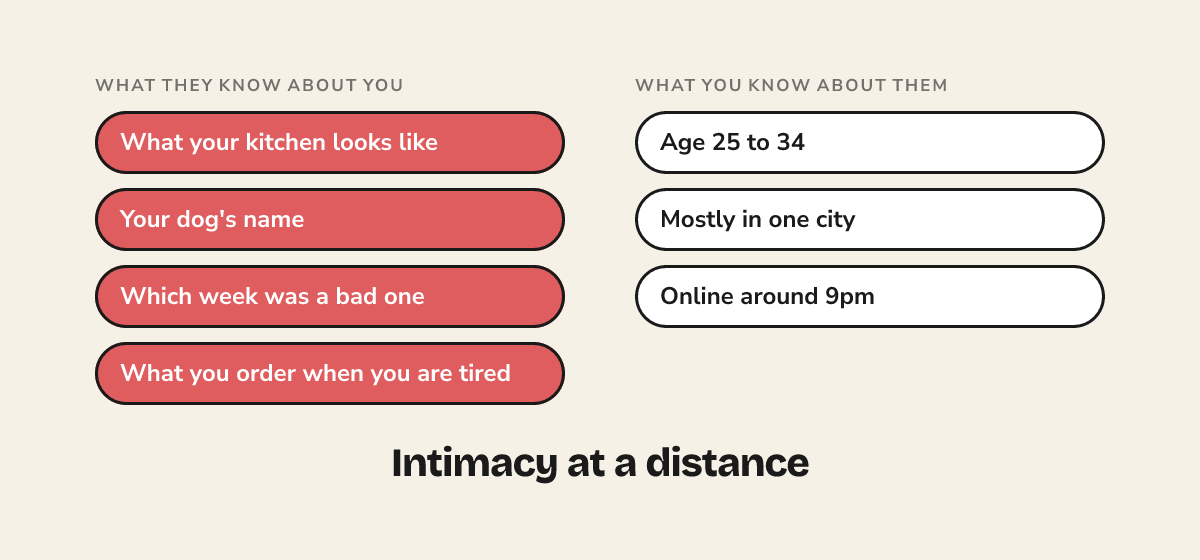
Somebody watched every story you posted this year. They know what your kitchen looks like and what you order when you are tired. They know which week was a bad one, because you said so in a voice note at 11pm. If they walked past you tomorrow, they would recognise you before you noticed them.
You know their handle, probably. Maybe their face, if they comment a lot. If they told you their name in person, it would mean nothing to you.
Neither of you chose that. It is just the shape a following comes in.
The one-sided relationship has a name
Two sociologists described it in 1956, long before anyone had a feed. Donald Horton and Richard Wohl were writing about radio and television hosts, and they called it para-social interaction: the sense a viewer has of knowing a performer who has no idea the viewer exists. The paper’s subtitle names it better than any summary: “intimacy at a distance.”
What they noticed was that it feels real from the audience side. The hosts spoke straight to the camera, as if to one person, and the audience answered in kind. People talked about hosts the way they talked about friends. They felt they understood them. All of it ran in one direction.
A feed makes the distance shorter than television ever did. You talk to the camera from your own sofa, you answer questions in your stories, you share the unglamorous parts on purpose. The intimacy is closer. It still only runs one way.
What the numbers tell you is not who they are
You are not short of information about your audience. You can see their age ranges, where they are, when they are online, which posts they saved.
None of it tells you who they are. It tells you where they are and when they scroll. It cannot tell you that many of the people who watch you closely grew up somewhere small, or are new parents, or care about the same things you keep coming back to in your captions. Nobody asked them, so nobody knows.
That is the gap that makes content feel like guessing. You make something, it lands or it does not, and you read the result like weather.
Getting to know someone takes both sides saying something
Every friendship you have began the same way. One of you said something real, and the other said something back. Knowing someone is not observation. It is an exchange.
A following skips the second half. Your followers have heard plenty from you. They have never had a way to say anything back that you would actually take in, beyond a comment that disappears under the next hundred.
So the useful question is not how to collect more about your audience. It is how to let them tell you who they are, on their own terms, in a way that gives them something too.
What the creator pilot is
The creator pilot is our attempt at that exchange, and it asks you for one Instagram reel or story.
You go first. You sign up with your handle and spend a few minutes chatting with Milo, who asks about your life, your values and what you care about. Your answers are what your followers line up against, which is why your own chat comes before anything else.
Then you post one reel or story. A reel uses ManyChat to DM your link to anyone who comments VILLAGE. A story carries your link on a Link sticker. Everyone who opens the link chats with Milo themselves and sees where they line up with you. Same kind of parent. Both grew up somewhere small. They care about the same things you do. For a follower, that is the first time the relationship has answered them back.
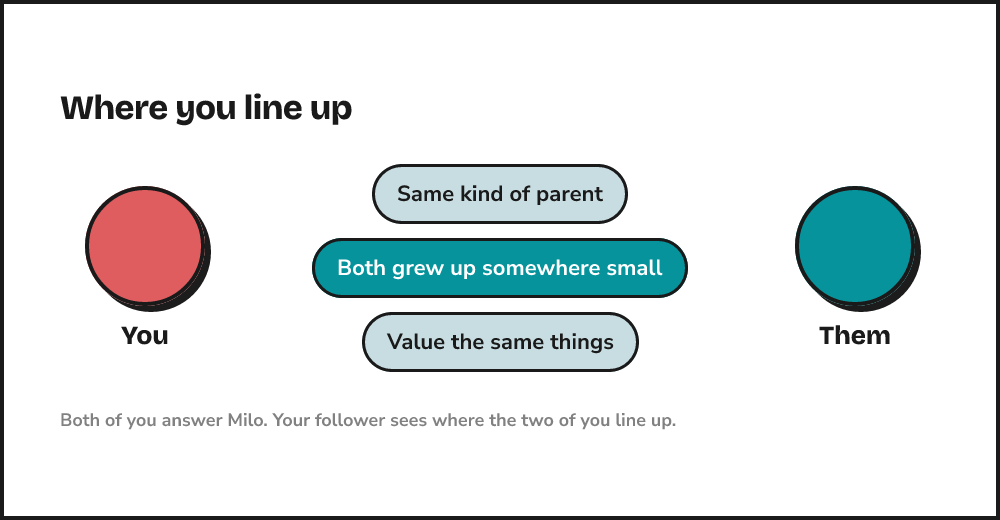
Your side is Creator Studio, which fills in with what your people have in common as a group, in the words they chose for themselves.
Why it is one post, not a campaign
One post is the right size for this, and you pick the kind. A story puts your link on a sticker anyone can tap, rather than a line in your bio that people have to go looking for. It is gone in a day, so it asks nothing of your grid. A reel works too: followers comment VILLAGE, and ManyChat sends them your link in a DM. Either way, nobody has to go looking for it.
Your kit makes it a few minutes of work. It has your link and story images made for you, with your photo and handle on them and a clear space at the bottom for the sticker.
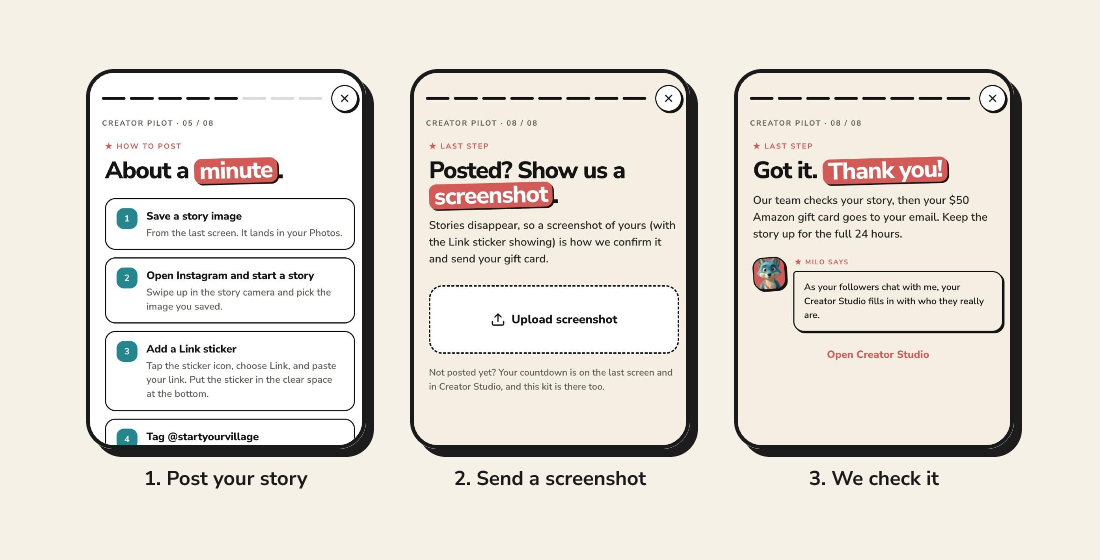
There is no call before you get the link, no link in bio and nothing to learn. If you want help with what to say, there are ideas and lines you can borrow. The posting guide has the five steps.
What you see, and what you do not
You see your audience as a group: what they have in common and what they told Milo about themselves. You do not see individual profiles, and nobody is ranked. Creator Studio waits until enough people have taken part that no one person can be picked out. The questions page covers the rest of what each side sees.
Your followers see you the way you described yourself to Milo. Nothing is scraped from your account.
The thank-you, and the small print
Post your reel or story within 7 days of finishing your chat, tag @startyourvillage, keep it up for 24 hours, and upload a screenshot in your kit. Someone on the team checks it. If your account is public and has 10,000 or more followers, they email you a $50 Amazon gift card. Every creator in the pilot gets six months of membership, free.
Open to US residents 21 and over. One $50 Amazon gift card per creator with 10,000 or more Instagram followers, sent after we confirm your post. Amazon is not a sponsor of this promotion. The full rules are numbered on their own page, so you know exactly what counts before you post.
If you have spent years being known by people you do not know, one post is a good place to start knowing them back. See how the creator pilot works, or go straight to joining it.
Para-social interaction and “intimacy at a distance” are from Donald Horton and R. Richard Wohl, Mass communication and para-social interaction, Psychiatry 19(3), 1956.